
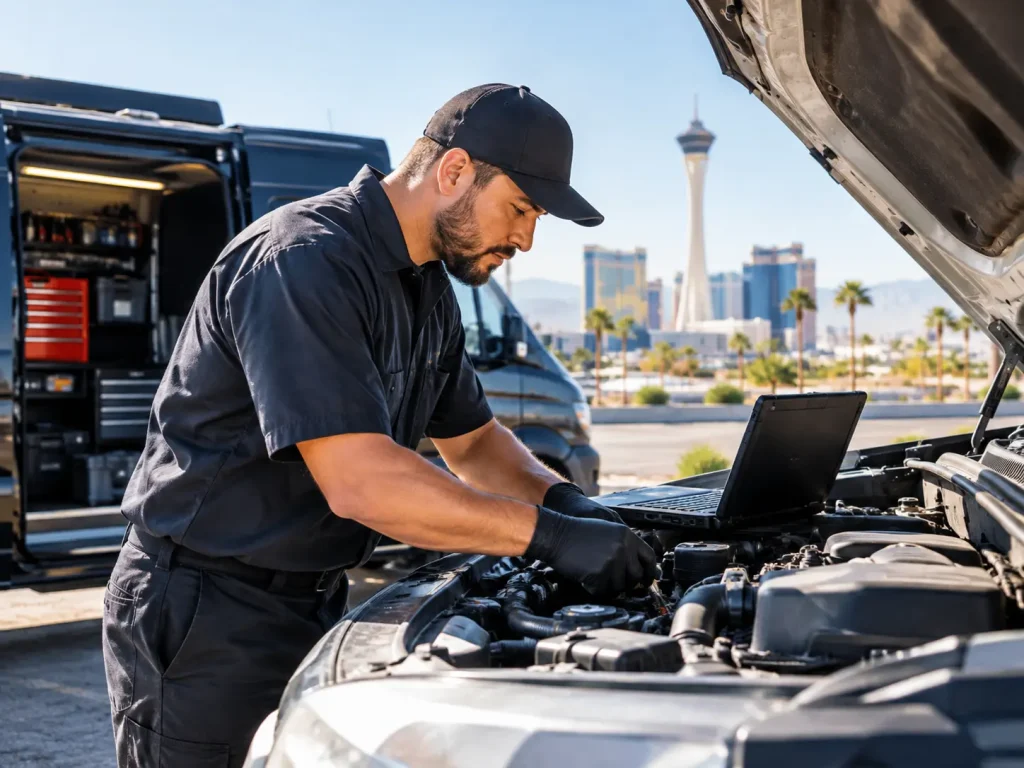
Few things protect your engine as quietly as coolant. It keeps the engine from overheating in the Florida heat, it protects internal parts from rust and corrosion, and it does its job every minute the car is running. But coolant does not last forever, and the level can drop without any obvious warning. Checking it takes only a couple of minutes, and it is one of the simplest ways to catch a leak or a cooling problem before it leaves you stranded on the side of the road. This simple DIY guide explains how to check your coolant level safely, what you are looking at, what the results mean, and when to call a professional. If you are in West Palm Beach and want help with engine overheating or a cooling system check, a mobile mechanic can come to you.
What Does Coolant Do?
Coolant, often called antifreeze, is a liquid that circulates through your engine and radiator. It absorbs heat from the engine, carries it to the radiator, and releases it to the air. It also contains additives that protect metal parts from corrosion, lubricate the water pump, and help prevent the liquid from boiling in hot weather or freezing in the cold. Most coolant is mixed with water, and the correct mixture and type for your vehicle are listed in your owner’s manual. Over time, the additives wear out, which is why coolant needs to be replaced on a schedule.
Why Checking the Level Matters
The cooling system is sealed, so the level should stay fairly steady. A level that keeps dropping usually means there is a leak somewhere, or in more serious cases that coolant is being lost inside the engine. Running low on coolant can lead to overheating, and overheating can damage the engine quickly. Heat and traffic make this even more important in South Florida, where the cooling system works hard for most of the year. A quick check every so often is cheap insurance.
Safety First: Never Open a Hot Cooling System
This is the most important part of the whole job. A hot engine’s cooling system is under pressure, and hot coolant can spray out and cause serious burns. Keep these rules in mind:
- Check the coolant only when the engine is completely cool, such as before the first drive of the day or after the car has sat for several hours
- Never open the radiator cap or the pressurized reservoir cap while the engine is hot or warm
- If the temperature gauge is high or there is steam, pull over safely, turn off the engine, and wait for it to cool before you do anything
- Keep your face, hands, and clothing away from the cap and any escaping vapor
- Keep coolant away from children and pets, since it is toxic and can smell and taste sweet, and clean up any spills right away
- Park on a flat surface so the reading is accurate
- Read your owner’s manual first, since the location of parts and the correct procedure vary between vehicles
If you are not comfortable with any of these steps, it is perfectly fine to have a technician do it.
What You Will Need
- A flashlight, since the reservoir can be hard to see
- A clean rag or paper towels
- Gloves and eye protection, to be safe
- Your owner’s manual, to confirm the coolant type and the location of the reservoir
- The correct coolant, only if you need to top off, as specified in your manual
How to Check Your Coolant Level Step by Step
Step One: Park on Level Ground and Let the Engine Cool
Park on a flat surface, turn off the engine, and let it cool completely. If you have been driving, wait several hours. The safest approach is to check it first thing in the morning before you start the car.
Step Two: Open the Hood and Find the Reservoir
Open the hood and secure it. Look for the coolant reservoir, also called the overflow or expansion tank. It is usually a translucent plastic tank near the radiator, often with a cap that shows a warning symbol, and with markings on the side. Your owner’s manual shows where it is on your vehicle. Do not confuse it with the washer fluid reservoir, which usually has a different cap and symbol, or with the brake fluid reservoir.
Step Three: Read the Level on the Side of the Tank
With the engine cool, look at the markings on the side of the reservoir. Most have a line for the minimum level and a line for the maximum level, sometimes marked low and full, or cold and hot. When the engine is cold, the coolant should sit between the lines, at or near the cold fill mark if there is one. Use a flashlight to see the level through the plastic if needed. If the level is below the minimum mark, it is low.
Step Four: Look at the Color and Condition
While you are looking, check the coolant itself. Coolant comes in different colors depending on the type, such as green, orange, pink, yellow, or blue. The color alone does not tell you everything, but its condition can. Warning signs include:
- A rusty, brown, or muddy look, which can point to corrosion or old coolant
- An oily film or a milky, sludgy appearance, which can mean oil or other fluids are mixing in and needs prompt professional attention
- Particles, flakes, or debris floating in it
- A level that is dramatically low with no visible cause
Coolant should look clean and clear in its color, without cloudiness or debris.
Step Five: Check for Leaks and Other Clues
Look around the engine bay and under the car for signs of leaks, such as wet spots, crusty residue, or stains on hoses and around the radiator. A sweet smell near the engine can also point to a coolant leak. Check the hoses for cracks, bulges, or soft spots, and the area around the water pump and radiator for traces of dried coolant. Puddles on the ground under the front of the car, usually brightly colored, are a sign that something is leaking.
Step Six: Top Off Only If Needed, With the Right Coolant
If the level is a little low, you can add coolant to the reservoir, but only the type specified for your vehicle. Using the wrong kind can cause damage, and mixing different types can create problems. Many people use a premixed coolant that is ready to use, and others mix concentrate with water as the label directs. Remove the reservoir cap carefully, only with the engine cold, add a small amount, and bring the level to the proper mark without overfilling. Replace the cap securely, and wipe up any spills. Keep in mind that topping off treats the symptom, and if the level drops again, there is a leak that needs to be found.
Step Seven: Do Not Open the Radiator Cap for a Routine Check
On most modern cars, the reservoir tells you what you need to know. You do not need to open the radiator cap as part of a routine check, and opening it carries more risk. If your owner’s manual calls for it, do so only when the engine is completely cold, using a thick rag over the cap and turning it slowly, and stay clear of any escaping steam or vapor. When in doubt, leave it to a professional.
What the Results Mean
- Level between the marks and the coolant looks clean: your system looks normal, and you can check again regularly
- Level slightly low: top off with the correct coolant, then watch whether it drops again
- Level low again soon after topping off: there is likely a leak, and it should be inspected
- Level very low or the reservoir is empty: do not drive the car, and have it checked, since overheating is likely
- Coolant that looks rusty, oily, milky, or full of debris: have a technician inspect the system
Signs Your Cooling System Needs Attention
- The temperature gauge reads higher than normal
- A temperature warning light comes on
- Steam or vapor from under the hood
- A sweet smell from the engine bay
- Puddles of brightly colored fluid under the car
- A heater that blows cool air when it should be warm
- A coolant level that keeps dropping
- A temperature that rises in traffic and falls at highway speed
If the engine overheats while you are driving, pull over safely, turn off the engine, and wait for it to cool. Do not keep driving, and do not open the cap. If your car will not start afterward, our guide to the top 10 reasons your car won’t start and how to get back on the road explains the common causes.
How Often Should You Check Coolant?
There is no single schedule that fits every car, but a quick check every month or so, and before long trips or the hottest part of the year, is a good habit. Your owner’s manual also lists when the coolant should be replaced, and following that schedule matters, since old coolant loses its protective qualities even if the level looks fine. Hot weather, towing, and heavy traffic all put more stress on the system, so more frequent checks make sense in those conditions.
When to Call a Professional
- The coolant level keeps dropping
- You see a leak you cannot identify
- The coolant looks oily, milky, or full of rust
- The engine overheats or the temperature gauge climbs
- You smell coolant or see white smoke from the exhaust
- You are unsure which coolant your car needs
- The system is due for a flush or replacement
A technician can pressure test the system to find leaks, test the coolant, inspect the hoses, radiator, thermostat, water pump, and fans, and replace coolant with the correct type. Our article on why mobile mechanics are better than traditional auto shops in West Palm Beach, FL explains how on site service can save time when you need a repair.
Can a Mobile Mechanic Check Coolant and Fix Cooling Problems?
In many cases, yes. A mobile mechanic can come to your home or workplace in the West Palm Beach area, check the coolant level and condition, inspect the cooling system, look for leaks, and handle many common repairs on site, such as replacing hoses, belts, a thermostat, or coolant. That is especially helpful when your car is not safe to drive. Some jobs, such as internal engine repairs or work that needs a lift or specialized equipment, may need a full shop, and a trustworthy technician will tell you honestly when that is the case. When you book, share your vehicle’s year, make, model, and mileage, and describe what you have noticed, such as a low reservoir, a leak, or a high temperature gauge.
A Two Minute Check That Can Save Your Engine
Checking your coolant is quick, easy, and well worth the habit, especially in a hot climate. Do it with the engine cold, look at the level and the condition, and pay attention to any change. If something does not look right, do not wait for the gauge to climb.
To learn more about our services, visit our homepage. If you would like your cooling system checked, reach out through our contact us page and we will come to you anywhere in the West Palm Beach area.